

UNFI Deductions: Types, Codes, and How to Dispute

Your UNFI remittance lands. The reason codes mean nothing without context. MCB, SSA, INV, AVL: each one is real money. Your remittance doesn't say whether the charge is valid, worth disputing, or caused by your team. By the time you find the backup, the dispute window is already running.
That's the real problem with UNFI deductions. Codes arrive faster than your team can sort them. Manual reconciliation burns the time you'd need to recover anything. In other words, UNFI deductions are actually a data problem before they're a dispute problem.
Brands that manage them well know which codes to challenge, which to accrue for, and which signal an upstream fix. That sorting discipline recovers margin and closes faster without adding headcount. Here's a guide for getting there.
Main Takeaways
- UNFI deduction codes fall into two groups: mandatory operational charges and discretionary promotional deductions tied to agreed trade programs.
- SSA and the 2% cash discount are contractual ongoing costs. They aren't disputable, so sorting by code type protects your team's time.
- Natural suppliers have a recommended 60-day dispute window through the Dispute Center. Conventional suppliers have up to 18 months via ePASS.
- Effective February 1, 2026, SSA deductions for Natural suppliers consolidate into one monthly charge per region. This shifts cash flow timing by two to six weeks.
- Fixing the operational root cause of a recurring deduction recovers more margin than winning a single dispute after the fact.
UNFI Deduction Codes: What Every Code on Your Remittance Means

Every UNFI deduction maps to a reason code. Those codes fall into two broad groups. First: operational and compliance charges that hit your remittance on their own. Second: discretionary or promotional deductions tied to programs you've agreed to. Each one can be identified, checked, and acted on once you know what you're looking at.
Operational and Compliance Deductions
These UNFI deductions result from logistics, compliance, or fulfillment issues. They show up on your remittance whether or not you expected them. They span challenges like:
- Short shipments: Deductions for units ordered but not received at the distribution center (DC).
- Overship charges: Penalties for delivering more than the purchase order (PO) quantity.
- Late delivery and appointment fees: Charges for missed delivery appointments, late arrivals, last-minute rescheduling, or no-shows. Arriving more than 30 minutes late costs $250. Showing up without an appointment or rescheduling with less than 24 hours' notice costs $300 each. A no-show with no call costs $500, per UNFI's supplier policies
- Spoilage: Product that arrives damaged or expires before sale.
- Freight allowances: Adjustments tied to shipping terms and freight cost-sharing.
- Pack changes: Charges triggered when pack setup doesn't match the PO.
- Recalls: Deductions for product pulled from shelves under a recall event.
Most operational deductions hold up when UNFI's documentation supports the charge. But many are avoidable upstream. Scheduling discipline, fill rate management, and invoicing accuracy prevent most of them. UNFI expects a 95% fill rate from suppliers, per UNFI's supplier terms. Falling below that threshold triggers shortage deductions on every affected PO. If fill rate issues persist for more than two weeks, UNFI expects a corrective action plan, and continued shortfalls can lead to delisting.
Discretionary and Promotional Deductions
These deductions are tied to trade programs you've opted into or agreed to as part of your supplier terms. Not everything in this group is optional; some, like SSA, are contractual once you're enrolled:
- Off-invoice discounts: Price reductions applied at the invoice level per your promo agreement.
- Distributor advertising programs: Fees for participating in UNFI marketing, merchandising, or promotional programs.
- Simplified Supplier Approach (SSA): An ongoing supplier allowance for Natural suppliers. It's commonly around 2.5% of purchases, though the exact rate depends on your agreement.
- Everyday Low Price (EDLP): Ongoing promotional allowances built into your pricing agreement.
- Scans: Performance-based deductions tied to retail sales or scan data.
- Manufacturer Chargeback (MCB): The core mechanism UNFI uses to recover promotional allowances from suppliers. UNFI provides backup documentation via email on request.
Discretionary deductions are tied to trade programs you've agreed to. They aren't necessarily errors, but they are disputable when the backup doesn't match the agreement. The standard 2% cash discount is generally considered a normal cost of doing business with UNFI. It's rarely disputed and often not worth challenging.
But be advised: there has been a 2026 SSA policy change. Effective February 1, 2026, SSA deductions for Natural suppliers moved from per-invoice deductions to one monthly deduction per region (East and West). That shifts the timing of deductions by about two to six weeks. Finance teams should update their accrual calendars and take three preparation steps: remove SSA allowance codes from Electronic Data Interchange (EDI) invoices, confirm the account transition with your UNFI Supplier Relationship Manager, and audit the first post-transition invoices to verify SSA no longer appears per invoice. Conventional suppliers are not affected. A 2026 analysis from Foodbevy details the timing effects for close planning.
The Code Reference Table: Operational, Compliance, Discretionary, and Promotional
UNFI assigns a reason code to every deduction on your remittance. The full code set spans hundreds of reasons across Natural and Conventional accounts. The Supplier Deduction Key is the official reference for the complete list. You can find it inside the UNFI Supplier Portal.
The table below covers the codes you'll see most often. It shows whether each is eligible for dispute and what documentation you need to challenge it.
The deduction process differs based on whether you're a Natural or Conventional supplier. That affects which portal you use, how long you have to dispute, and which fee structures apply.
Common ongoing costs include the 2% cash discount and, for Natural suppliers, SSA. Other costs depend on your supplier agreement: annual advertising agreements billed quarterly, per-SKU fees for launching into new DCs, and a payment hold on your first purchase order.
Trade spending consumes roughly 20% of gross sales for most CPG companies, according to Strategy& (PwC), and distributor deductions are a large share of it. That's why organizing deductions by code type is one of the most effective ways to protect margin without wasting time on blanket disputes.
The Deduction Triage Framework: Valid, Invalid, or Preventable

Before you dispute anything, sort every deduction into one of three buckets:
- Valid: Accept and accrue
- Invalid: Dispute with documentation
- Preventable: Fix the root cause so it stops recurring
The dispute window for Natural suppliers is already running from the deduction date on your remittance. Your team's time is the most limited resource you have.
Bucket 1: Valid and non-disputable. These are deductions where UNFI's documentation supports the charge and the terms are agreed. SSA fees, the cash discount, and promo deductions with matching MCB backup all fall here. The action is simple: accept, accrue, and code to the correct general ledger. Disputing valid deductions wastes cycles and hurts your standing with UNFI's deductions team. That makes it harder to recover on charges that actually deserve attention.
Bucket 2: Invalid and worth disputing. These are deductions where the charge doesn't match the documentation, the amount is wrong, or the deduction is a duplicate. A short shipment deduction where your BOL shows full delivery belongs here. So does an MCB deduction with no matching promo agreement, or duplicate charges across remittances. Flag them for dispute right away. The window starts from the deduction date, not when you notice it.
Natural suppliers should file within 60 days through the Dispute Center. Conventional suppliers have up to 18 months via ePASS. Win rates vary by type. Operational deductions with clean proof of delivery tend to resolve faster than promotional disputes. Platforms like TrewUp use AI to match each deduction to its reason code and backup, flagging duplicates and errors before a person ever opens the remittance. That's what makes the dispute window workable when you're processing dozens of deductions per check run.
Bucket 3: Operationally preventable. These deductions are valid because UNFI's documentation supports them. But they result from operational issues your team can fix. Late delivery appointments trigger fees of $250 to $500 depending on severity. Scheduling deliveries within the distribution center's appointment window helps prevent them (one day for Natural, three days for Conventional). Fill rates below 95% can also lead to shortage deductions. Better inventory planning helps reduce those charges.
Some deductions point to process gaps rather than shipping issues. Invoice (INV) deductions often result from invoicing errors, such as inaccurate EDI data or incorrect East/West customer assignments. MCB deductions are harder to validate if your team never receives the supporting documentation. Signing up for UNFI's MCB backup emails helps ensure every promotional deduction can be reviewed. Suppliers can request enrollment through UNFI's deduction dispute management team at supplierdeductiondisputemgmt@unfi.com, or confirm the current contact in the Supplier Portal. Either way, this bucket is where margin recovery actually lives.
The fix that stops a deduction from recurring next month is worth more than winning the dispute this month. Without sorting discipline, deduction volume scales into missed dispute windows, undetected repeat charges, and a gap between Finance and Sales on trade spend actuals. Those are the failure modes that turn a workable process into a backlog that grows every check run.
How to Dispute a UNFI Deduction Step by Step

The UNFI dispute process runs on four steps: review, check your window, submit with documentation, and track. The gap between recovering money and writing it off usually comes down to one thing. Did you have the backup ready before the deadline hit?
Step 1: Review Your Remittances
Pull the remittance from the UNFI supplier portal. Identify the deduction code using the reference table above. Note the amount and match it to the invoice it maps to. Confirm the deduction falls in your "invalid" bucket before you spend time building a case. If it belongs in Bucket 1 or Bucket 3, your time is better spent on accruals or operational fixes.
Step 2: Check Your Dispute Window
Natural suppliers have a limited dispute window from the deduction date. The Dispute Center, launched in 2026, denies adjustments older than 12 months, per UNFI's Dispute Center guidelines. Backup documentation is only available for up to 90 days, so waiting even one quarter can leave you without the evidence to build a case. Conventional suppliers have up to 18 months to dispute via ePASS. UNFI recommends submitting within 60 days for faster answers. Certain deduction types may carry stricter internal deadlines. Check the specific code's documentation needs before assuming you have the full window.
Step 3: Submit Your Dispute
Natural suppliers complete the UNFI Natural Supplier Dispute Form (an Excel template). UNFI only accepts the form in Excel format, not as a PDF or screenshot. Email it to Deductions@unfi.com with all supporting documentation attached, using a subject line that lists your brand name, check number, deduction invoice number, and dispute amount. The Dispute Center also offers search, tracking, and appeal features for submissions.
Required documentation varies by deduction type:
- Short shipment disputes: BOL and proof of delivery
- Damage and spoilage claims: photos
- Promotional disputes: promo agreements and MCB backup emails
Conventional suppliers submit through ePASS with the same documentation standards. The Natural vs. Conventional table in the code reference section maps the portal and window differences. Incomplete submissions stall answers. Attach everything on the first submission.
Step 4: Track Your Case
UNFI typically responds with a tracking number within two business days. Expect answers in 30 to 45 days. Each dispute carries a status you can track: Received, In Process, Repayment Pending, New Invoice Requested (documentation incomplete, resubmit), Denied, or approved but awaiting release. Status updates arrive weekly by email.
If denied, Natural suppliers can appeal through the Dispute Center. Track open disputes by deduction type and age. If a category keeps getting denied, that's a signal to move it from your "dispute" bucket to your "prevent" bucket.
The dispute process itself is simple: four steps, documented timelines, clear channels. The hard part is having the backup ready and the sorting done before the window closes. That's harder when you're processing dozens of deductions per check run across Natural and Conventional accounts.
Start Managing UNFI Deductions with TrewUp

You now have a framework for sorting UNFI deductions by code type. You know which ones deserve your team's time and when the root cause is operational. That means you can protect margin without disputing everything that hits your remittance. The right software makes it even easier.
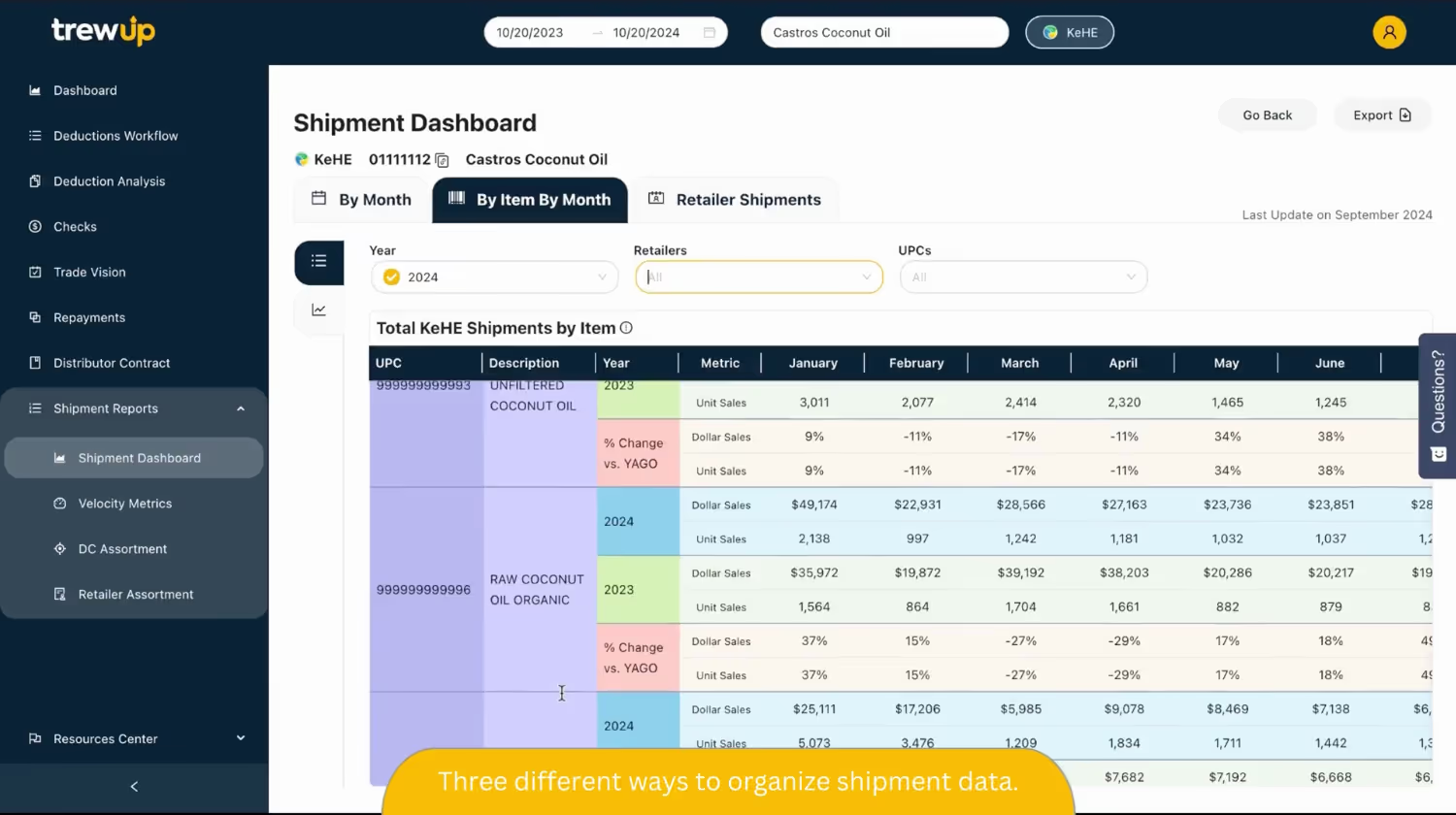
We built TrewUp to connect directly to UNFI and categorize deductions by reason code on its own. Proprietary AI matches each deduction to its code, agreement, and backup, so your team spends time on recovery and prevention, not manual reconciliation. Every location's deductions are visible in one place with 12 months of data at onboarding. You can spot repeat charges before they grow, close each month knowing your numbers are right, and turn deduction actuals into smarter trade spend decisions.
See how our deduction management software handles UNFI categorization, dispute tracking, and recovery workflows without adding manual steps to your close process.