

You planned a promotion at a 15% rate. The deduction that settled three months later came in at 22%. No one on your team can trace where the gap came from. By the time you noticed, the promotion had already run at four other retailers using the same numbers.
Trade promotion execution creates chargebacks, billbacks, and scan-backs that arrive weeks or months after the promotion ends. Your finance team matches planned spend against actual deduction activity long after the invoice cleared, often without the records needed to verify whether each claim fits the agreed terms. Until you connect promotion actuals to deduction data, every return on investment (ROI) number is built on estimates, not outcomes.
Main Takeaways
- Trade promotions are business incentives manufacturers give retailers and distributors, not consumer-facing deals. Each type carries its own deduction structure that sets true net margin.
- They represent 11% to 27%+ of Consumer Packaged Goods (CPG) revenue.
- Less than half of trade promotion dollars produce a positive ROI, and the deduction actuals that prove it land weeks or months after the promotion ends.
- Measuring true ROI means connecting depletion data, scan data, and deduction actuals back to the original investment by retailer and stock keeping unit (SKU).
- Trade promotion management tracks planned events. Trade promotion optimization evaluates which promotions actually delivered, using real financial outcomes.
Trade Promotion Types and How Each One Generates Deductions

A trade promotion is a business-to-business incentive a manufacturer offers a retailer or distributor. Think discounts, displays, allowances, or fees meant to drive product visibility and velocity. Consumer promotions target the end shopper. Trade promotions target the retail partner. CPG companies spend between 11% and 27%+ of revenue on these programs, according to the Promotion Optimization Institute. That makes trade spend one of the largest line items on the profit and loss statement (P&L).
Trade Spend vs. Marketing Spend: What Scaling Brands Need to Know
Trade spend funds the promotions, slotting fees, and allowances that keep your products on shelves. It is not optional. If you sell through retail, you spend trade dollars. Marketing spend (brand ads, social media, sampling) is a budget you choose. Scaling brands that lump trade into a "marketing line item" undercount their locked-in costs. They also overstate the margin they have left to work with.
Each promotion structure creates its own deduction type, and those deductions set true net margin. A slotting fee for a new SKU at a regional chain creates a different deduction than a scan-back tied to an endcap at Kroger. The table below maps five core promotion types to how they are funded, the deduction each creates, and the ROI question each one raises.
Five Trade Promotion Types and the Deductions They Create
Every promotion type in that table produces a financial event your finance team will need to process. The further that event lands from the original invoice, the harder it becomes to match without a clear workflow.
Why Trade Promotions Fail: Where the Money Actually Goes

Most failed trade promotions break down between execution and financial matching. The strategy is rarely the issue. By the time anyone sees it, the dollars are already spent.
Salesforce reports that just 46% of trade promotions deliver a positive return, a number that has barely moved in years. NIQ found that only about half of promotional sales are truly incremental, which means the other half would have sold without the promotion. Brands are paying for volume that was already coming.
The root causes are operational, not strategic:
- Data silos leave sales planning and finance working from partial information, often pulled from separate portals, spreadsheets, and email threads.
- The promotion that actually ran in-store often does not match what was planned.
- Deduction volume spikes that nobody budgeted for hit the P&L weeks later.
The pattern is simple: when you can't see what a promotion actually cost until months after it ended, overspending grows quietly. Each promo cycle inherits the blind spots of the last one. Incremental ROI erodes before anyone has the data to course-correct.
Trade Promotion Management vs. Trade Promotion Optimization
Trade promotion management (TPM) gives you a system of record. It is a place to plan, budget, and track promotional events. Trade promotion optimization is a different discipline. It uses analytics to evaluate which promotions delivered and to sharpen future decisions. The two solve different problems.
79% of CPG companies already run TPM systems, yet 67% still describe the end-to-end process as "burdensome," per the Promotion Optimization Institute. A TPM gives you a plan on file. It does not give you proof that the plan delivered. Optimization picks up where management leaves off, connecting planned spend to actual outcomes through deduction actuals, depletion data, and joint business planning reviews. That shift from planning to proof is the core of trade spend optimization: judging every dollar by what it actually returned.
What Happens After the Promotion Runs: Deductions and Financial Matching

The promotion ends. The financial work is just starting. Retailers and distributors file claims against the original terms. Those claims land on your remittance as deductions. You know the three that dominate: chargebacks, billbacks, and scan-backs. Each one arrives through a different portal, in a different format, on a different timeline.
Your finance team matches each claim back to the original promotion plan. They check the amount, the terms, and the backup records. Claims that align get cleared. Claims that don't get disputed. Claims that can't be matched either way sit in a backlog until someone writes them off.
Matching is where most teams lose the thread. Promotional activity keeps rising. In its 2025 industry outlook, Deloitte reported that 76% of consumer products executives surveyed planned to offer more sales discounts and promotions than they had in 2024. Deduction volume climbs right alongside that spending. Without automated categorization and matching, backlogs grow faster than teams can clear them. Sonoma Creamery, a mid-market brand, uncovered $60K in incorrect deductions only after gaining visibility into how claims mapped to actual promotion terms through TrewUp. That kind of gap is common. It usually just goes unseen.
When matching falls behind, unresolved claims pile up and age toward write-offs. Every promotion that runs in the meantime adds to the backlog before anyone has cleared the last one.
How to Measure Trade Promotion ROI Using Actuals, Not Estimates

Measuring true trade promotion ROI requires three data sets, each connected back to the original promotion investment:
- Depletion data: units sold through to retailers.
- Scan data: actual units moved at the promotional price.
- Deduction actuals: the chargebacks, billbacks, and scan-backs your finance team has already processed.
Bring those together and the result is a real number by retailer and SKU, not an average built on guesses.
Calculate True ROI in Five Steps
- Start with the original promotion plan: the agreed rate, terms, and expected volume.
- Pull depletion and scan data to measure the volume the promotion created.
- Subtract baseline volume to isolate the incremental units, the ones that wouldn't have sold without the deal.
- Pull deduction actuals to see what the promotion actually cost.
- Do the math: incremental revenue minus actual promotion cost equals true incremental ROI.
That final step is the one most teams shortcut. Swapping planned spend in for deduction actuals is faster, but it hides the gap between what you budgeted and what the promotion actually cost, which is exactly where margin leaks live.
Adjust for Cannibalization and Halo Effects
Baseline subtraction handles part of the problem, but two effects still distort the picture:
- Cannibalization: a promotion on one item pulls volume from another item in your own lineup, so the sales you count as incremental are partly just shifted off a full-price SKU.
- Halo effect: a promoted item lifts sales of related items that were never on deal.
Gross lift ignores both. It counts every promoted unit as a win and misses the volume you stole from yourself or gained next door. A promotion can look successful at the item level while flat or negative across the category once cannibalization is netted out. Measuring each promotion at the item level, then reading the result against the rest of the portfolio, is the only way to see what it actually added versus what it only moved around.
Measure ROI by Retailer, Not in Aggregate
For mid-market brands running promotions across multiple banners and distributors, this math has to happen per retailer and per item. Aggregate numbers hide weak performers. Run-A-Ton Group cut 20 hours per week from deduction processing by automating categorization through TrewUp, which freed their team to run these calculations instead of sorting backup records.
Promotional intensity remains high, and as the numbers above show, fewer than half of trade dollars earn back a positive return. Brands that can measure true incremental ROI by retailer and item will make sharper trade spend decisions. The ones that cannot will keep funding the volume they would have gotten anyway.
Where AI Actually Helps With Trade Promotion ROI
Most trade promotion content frames AI as a forecasting tool that predicts which promotions will work. That matters, but it sits upstream of the problem most finance teams actually have. The harder problem comes after the promotion runs, when deduction actuals arrive in different formats, through different portals, on different timelines. That is where AI earns its place.
AI categorizes deductions by type, reason, and customer the moment they land, instead of weeks later after someone sorts through backup files by hand. It matches each settled claim against the original promotion terms and flags the ones that do not line up. The chargebacks, billbacks, and scan-backs that used to sit in a backlog get sorted and surfaced fast enough to act on.
This is what makes trade spend optimization workable at scale. You can calculate true incremental ROI by hand for one promotion at one retailer. Across dozens of promotions running at multiple banners, manual matching breaks down and the backlog wins. AI handles the volume so your team works from clean, categorized deduction data instead of guesses. The ROI number you report is only as good as the actuals behind it, and AI is what keeps those actuals clean.
Trade Promotion Execution Checklist
Use this checklist to close the gap between what you planned and what actually settled. Run it for every promotion, at every retailer.
- Record the original terms before the promotion runs: agreed rate, dates, expected volume, and proof-of-performance requirements.
- Pull depletion and scan data once the promotion ends to measure the volume it created.
- Subtract baseline volume and account for cannibalization to isolate true incremental units.
- Match every settled deduction against the original terms by retailer and SKU.
- Flag any chargeback, billback, or scan-back that falls outside the agreed terms, and dispute it inside the retailer's window.
- Reconcile deduction actuals before you report ROI, so the number reflects real cost, not planned spend.
- Compare results across retailers to see which banners and items earned their spend and which funded volume you would have gotten anyway.
Turn Trade Spend Data Into Decisions Your Team Can Act On With TrewUp
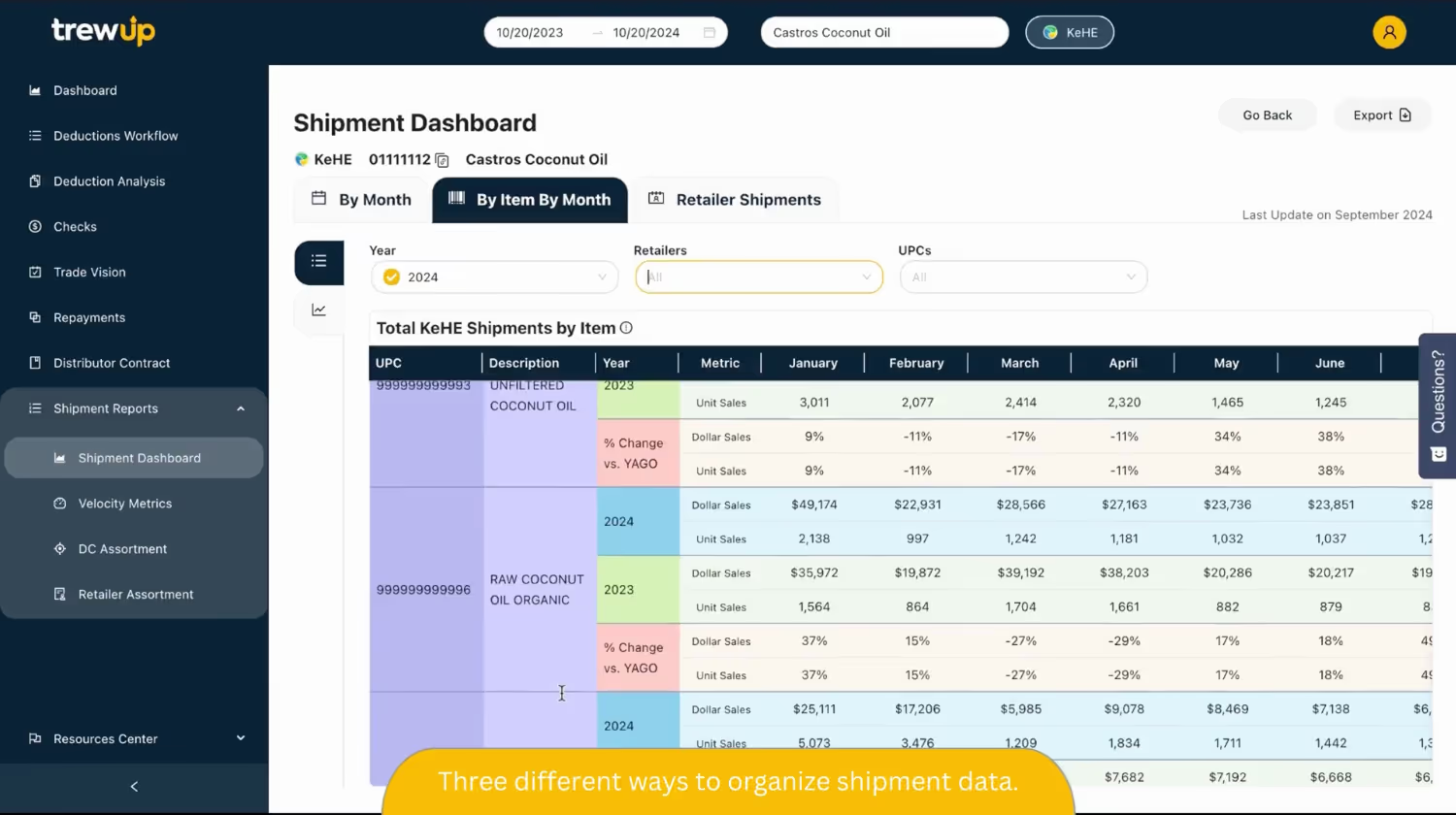
TrewUp connects promotion actuals to deduction data automatically. That lets you calculate true net margin impact by retailer and item, using what the promotion actually cost. Your team measures trade ROI from real chargebacks, billbacks, and scan-backs instead of planned spend estimates. Sales and finance work from the same numbers. Disputes get flagged before they age out. And you catch margin erosion while there is still time to act on it.
Book a demo to see how TrewUp turns fragmented trade data into general-ledger-ready actuals your team can trust.