.webp)

You process chargebacks, billbacks, and promo claims in distributor portals. Documents arrive in pieces, spread across PDFs, EDI files, and retailer systems. Backlogs grow until dispute windows close, then write-offs become unavoidable.
You need a way to catch up and stay on top of your work. This guide can help.
We’ll lay out a CPG-focused triage model and 30-day plan to help you get current on deduction work. You’ll learn how to turn deductions into GL-ready actuals.
The result? Ownership stays clear by type. Categories stay consistent. Close confidence improves because you know what’s open, what’s disputed, and what’s resolved.
Main Takeaways
- Accounts receivable (AR) deductions in CPG are customer-initiated invoice adjustments.
- Each deduction type requires different documentation, dispute windows, and ownership between finance, sales, and operations teams.
- A six-step process moves deductions from intake through categorization, validation, dispute, posting, and reporting.
- To recover more, triage backlogs by disputable dollar value and days until dispute windows close.
- Automate intake, extraction, and categorization first since these high-volume tasks create backlogs when done manually.
What Accounts Receivable Deductions Management Means in CPG
.webp)
Deduction management in AR includes receiving, categorizing, checking, and resolving customer invoice adjustments. These items may be:
- Chargebacks
- Billbacks
- Promo claims
- Compliance fees
- Other adjustments
Customers take these deductions against invoices before or after payment.
This critical process ensures that discrepancies—such as pricing errors, damaged goods, or unauthorized discounts—are managed to recover revenue, maintain accurate cash flow, and strengthen customer relationships.
CPG Deduction Types, Sources, and Ownership
CPG deductions fall into clear categories, each with different sources, documentation, and dispute windows that require specific handling. Each type needs specific backup and its own dispute timeline.
The table below maps common CPG deduction types by source, required evidence, and primary owner.
Overview of Common CPG Deduction Types
The Six-Step Process: From Intake to GL-Ready Actuals
.webp)
You need a consistent sequence to move items from received to resolved:
- Intake
- Categorize
- Validate
- Route/Dispute
- Resolve/Post
- Report
Skipping steps breaks clean close and inconsistent categories undermine accrual true-ups.
Intake and Categorize
Intake pulls deductions from all sources into one queue. They can arrive from:
- Distributor portals (UNFI, KeHE)
- Retailer compliance programs
- EDI 812 files
- PDF debit memos
- Broker submissions
Standard fields at intake include deduction date, customer, amount, claimed reason code, invoice reference, and document attachments.
Each incoming item is assigned a type, such as chargeback, billback, or promo claim.
Validate
Validation checks the deduction against your records: Does the promo exist? Does the POD support the delivery claim? Is the pricing agreement current?
A valid deduction has documents that match the claim—the promo ran as planned, the shortage occurred, or the compliance fee is supported by delivery data.
An invalid deduction lacks matching proof, falls outside the authorized program, or duplicates a claim you already processed.
Set decision rules by deduction type. For example:
- Promo claims: Check promo authorization. Verify scan data or lift report. Confirm retailer, item, and date range match.
- Compliance fees (OTIF): Match against your POD, BOL, and appointment confirmation. If the delivery was on time and in full, dispute with evidence.
- Shortages: Compare shipped quantity (BOL) against received quantity (POD). If they match, dispute the shortage claim.
- Pricing discrepancies: Verify the pricing agreement in effect at the invoice date. If your price was correct, dispute using the agreement copy.
Route/Dispute
Items are then routed to the right owner for credit memo issuance and clearing:
- AR handles pricing and post-audit items.
- Sales/Trade handles promo claims and billbacks.
- Ops handles shortages and compliance fees.
SLA expectations are set for each owner to keep process timelines clear. For example:
- AR completes categorization within 48 hours.
- Sales validates promo linkage within 5 business days.
- Ops researches shortage claims within 3 business days.
Teams dispute any invalid items within the customer's allotted window. This is often 30–180 days.
Resolve/Post and Report
Teams then post items to the correct trade spend bucket, such as promo, compliance, and spoilage. This supports expected-vs-actual accrual true-up at month-end.
GL-ready actuals need consistent categories, clear trade bucket mapping, and detailed status history (open, disputed, resolved, and written off). This keeps financial reports accurate. It also helps analyze trade promotion ROI and ensures audit compliance.
Your 30-Day Stabilization Plan
First, identify the following for each item:
- Disputable dollar value
- Days until dispute window closes
- Deduction type
- Promo linkage confidence
- Customer
Then, follow this week-by-week plan that focuses on recoverable dollars and steady throughput.
Steps to Stabilize Your Accounts Receivable Deductions Process
According to the National Retail Federation, US retail returns reached $890 billion (16.9% of sales) in 2024. Promotion intensity has also risen. 28.6% of products were sold on promotion by mid-2024, per the Financial Times.
Build surge cadences into your Q4 SOP, with daily reconciles and extended hours. This helps you avoid missing dispute windows.
Metrics That Show Deduction Health, Not Just AR Aging

Accounts receivable is now the largest share of excess working capital in the US. It’s a $600 billion opportunity, according to The Hackett Group. This makes deduction processing a CFO-level priority.
Track deduction health with workflow metrics that capture backlog, disputable exposure, resolution speed, and trade spend accuracy. You need deduction metrics tied to outcomes:
- Open deduction balance: Total money in queue, by status (new, in-research, disputed, pending resolution)
- Disputable exposure: Amount still within the dispute window that hasn't been submitted—this is your recoverable opportunity
- Resolution cycle time: Average days from intake to resolution, segmented by retailer/distributor and deduction type
- Promo vs. non-promo mix: Percentage of deductions tied to promotions, which helps identify accrual accuracy risk
- Write-off rate by category: Percentage of deductions written off, segmented by type and customer, to flag systemic issues
- Dispute win rate: Percentage of disputes resolved in your favor, which measures validation quality and evidence pack effectiveness
What to Automate and How to Evaluate Software
.webp)
Finance workload rose 5% in 2024, while headcount and budgets fell 1%, reports CFO.com. This makes manual PDF and portal research unsustainable at scale.
To keep your workflow moving, automate time-heavy tasks with low judgment:
- Intake
- Extraction
- Categorization
- Routing
Per Gartner, 58% of finance functions used AI in 2024—including for process automation and error detection. AI helps find patterns, like duplicates, and aids in extraction accuracy. Its value comes from specific automations.
Look for deduction management software with automation capabilities, plus:
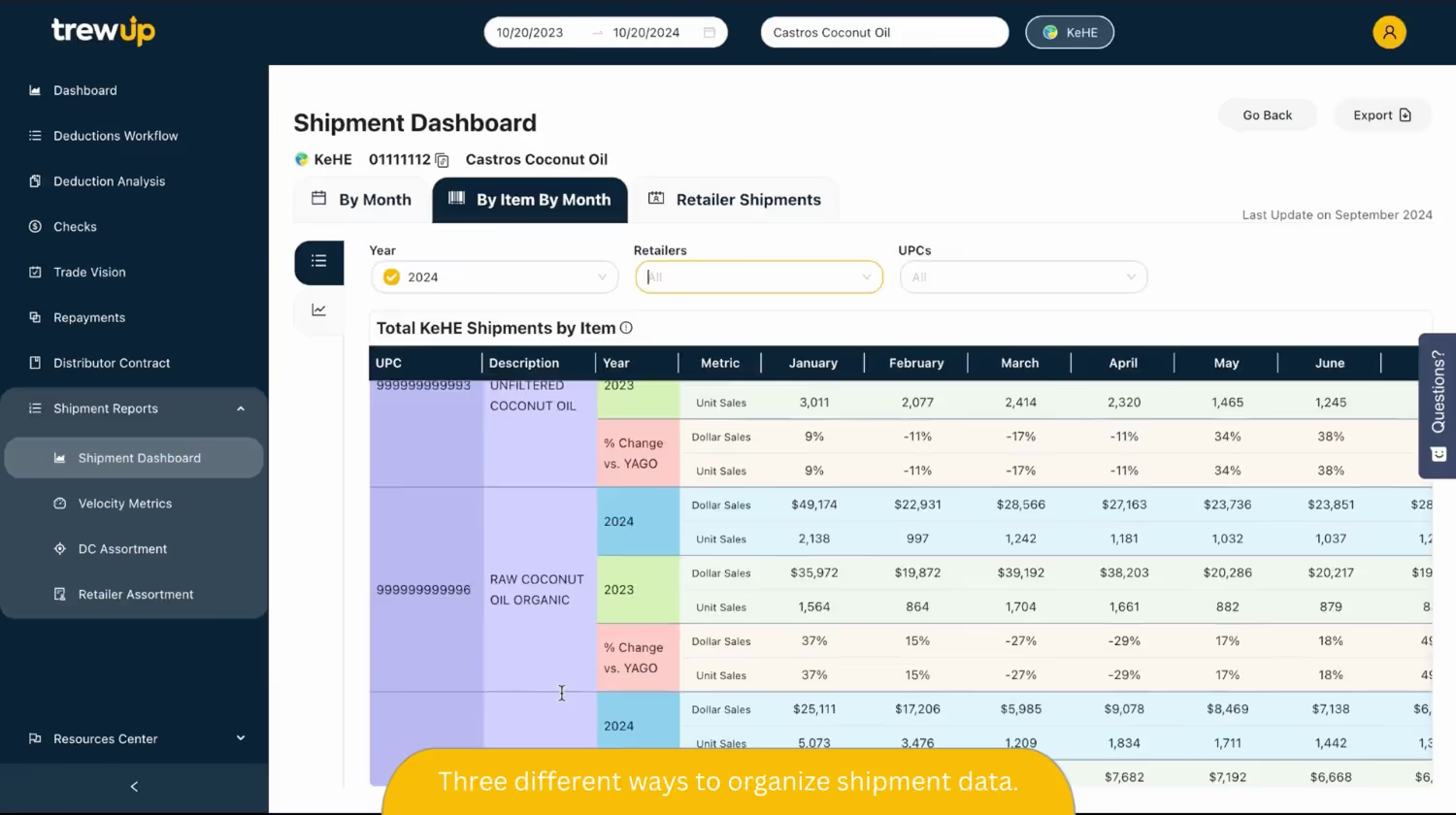
- Portal/PDF retrieval: Does it pull deductions from the distributor and retailer portals you actually use (UNFI, KeHE, retailer-specific)?
- EDI 812 parsing: Does it ingest and structure EDI 812 credit/debit adjustment files?
- Field extraction: Does it extract key fields (amount, date, reason code, invoice reference) from PDFs and debit memos?
- Categorization rules: Does it apply consistent categorization based on reason codes and document content?
- Routing logic: Does it route deductions to the right owner based on type?
- Dispute tracking: Does it track dispute status, submission dates, and response windows?
- GL-ready export: Does it produce outputs that map to your trade spend buckets and integrate with your ERP?
The table below compares these capabilities along with review questions for vendors.
Deduction Management Software Evaluation
Check how fast the vendor’s system can go live. It should take weeks, not months. Ensure ERP integration and links to cash application workflows for minimal disruption to your existing process.
What Working Deduction Processing Looks Like
When deduction processing works, you stay current, close with confidence, and trade spend becomes a controlled line item instead of a backlog-driven write-off risk.
- Deductions are processed weekly or faster, so the backlog stays flat or shrinks.
- Dispute windows are met.
- Visibility improves by retailer, item, and trade bucket.
- Your expected-vs-actual accrual true-up becomes a reconciliation.
Uncertain about your backlog and accrual risk? Request a free Trade Spend Health Check.
Stay Current on Deductions and Close with Confidence
Accounts receivable deductions management in CPG requires a consistent process to maintain accuracy, stay within dispute windows, and turn results into GL-ready trade spend actuals.
TrewUp keeps your workflow optimized. Every deduction is summarized cleanly, so accurate validation is faster, easier, and repeatable.
It automates extraction, categorization, and routing to ensure consistency and save you time. And it identifies recurring deduction patterns and root causes, flagging high-risk items so you know where to focus.
To see how TrewUp can help you run a sustainable AR deductions management process with clarity and confidence, book a demo.