

The Trade Spend Lifecycle: A 7-Stage Guide for CPG Brands

Trade spend is one of the largest controllable levers on a CPG brand's P&L, and one of the least understood. Cost of goods sold is a bigger line item for most brands, but it's largely fixed. Trade spend is smaller by comparison, but it's almost entirely variable, which is exactly what makes it worth managing closely instead of reacting to after the fact.
The problem is that trade spend doesn't happen in one place. It moves through a full lifecycle: a promotion gets planned, it runs in the field, it generates a deduction, that deduction gets processed and accounted for, and at some point, ideally, someone looks back at the results and decides whether to repeat, adjust, or kill the promotion next time. Every stage depends on the one before it, and most brands only have real visibility into one or two of the seven.
This guide walks through all seven stages of the trade spend lifecycle: what's supposed to happen at each one, where it typically breaks down for mid-market brands selling through UNFI, KeHE, and Kroger, and what it actually takes to close the loop.
Main Takeaways
- Trade spend is one of the largest controllable levers on the P&L. COGS is large but mostly fixed. Trade spend is smaller but highly variable, which is exactly why it deserves the same rigor.
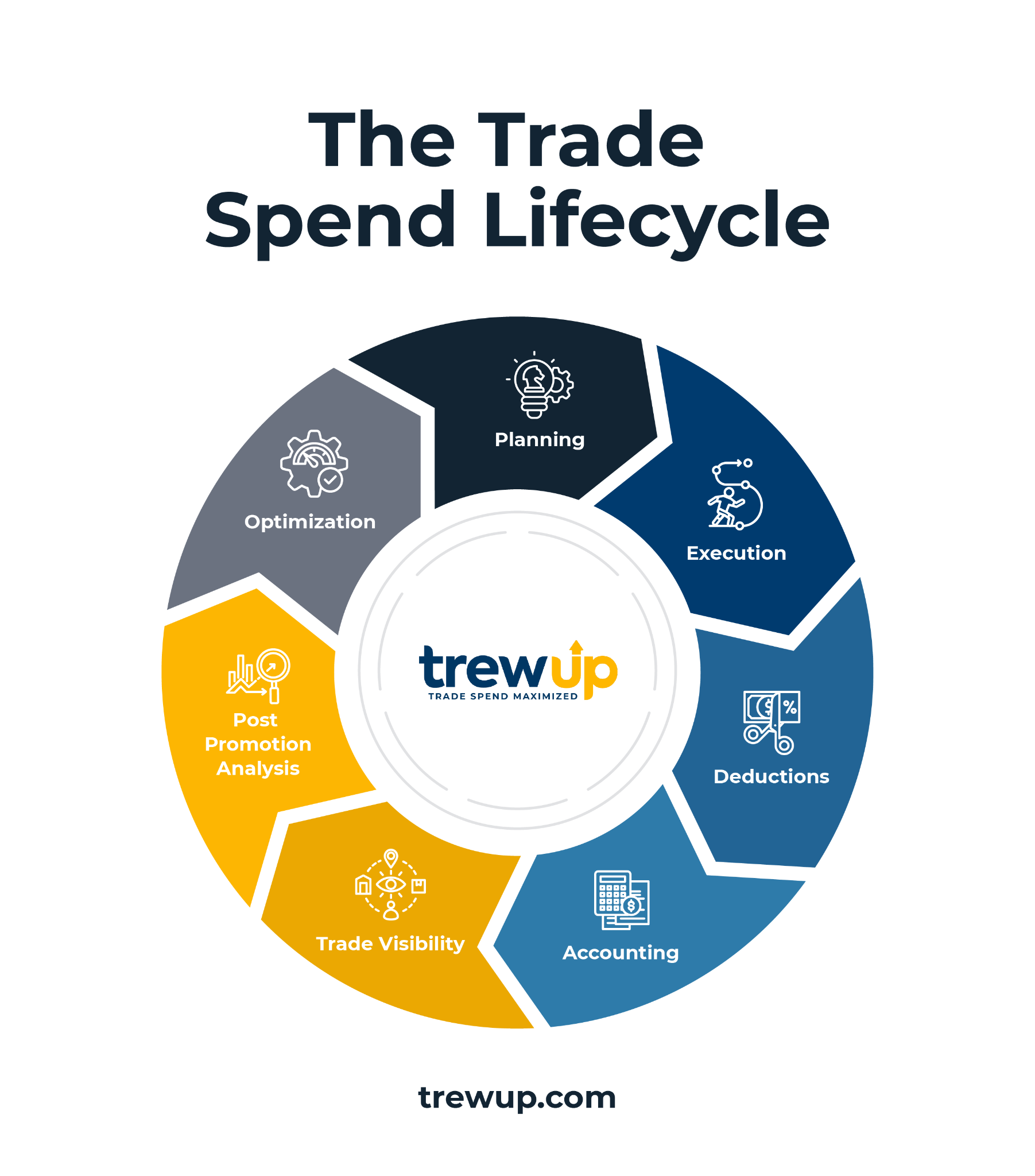
- The lifecycle has seven stages: planning, execution, deductions, accounting, trade visibility, post-promotion analysis, and optimization. Skip or weaken any one and the feedback loop that's supposed to make trade spend smarter over time never closes.
- A brand's annual trade rate is roughly a function of depth (how deep the discount is) and frequency (how often it runs). Most brands can name their total trade rate. Few can explain what's actually driving it.
- Deductions are the moment the truth about a promotion first surfaces, but for brands on UNFI and KeHE, that truth usually arrives as a lengthy PDF, not a clean data set.
- Post-promotion analysis is the stage almost every brand says it wants to do consistently. It's also the one most consistently skipped, because it requires pulling together data from several sources by hand.
What Is the Trade Spend Lifecycle?
The trade spend lifecycle is the full path a promotional dollar takes: from the moment a brand commits to it, through execution in the field, into the deduction a distributor or retailer takes, through the accounting work to make sense of it, and finally into the analysis that should determine whether the same promotion runs again.
It isn't a straight line. It's a loop. What a team learns from a promotion is supposed to shape the next one. When that loop closes, trade spend gets a little smarter every cycle: better estimates, fewer surprises, more confident decisions about where to spend next. When it doesn't, and for most mid-market brands it doesn't, teams end up repeating the same promotions, absorbing the same questionable deductions, and building next year's plan by copying last year's, because nobody had the time or the data to do anything else.
The 7 Stages of the Trade Spend Lifecycle
1. Planning
Promotions get planned annually or semi-annually, sometimes in trade promotion management (TPM) software, sometimes in a spreadsheet, and sometimes in nothing more formal than a conversation with a broker or retailer. All of those count as planning. The tool isn't really the issue. The issue is that most brands commit to a promotion without modeling its true cost, because they don't have reliable actuals from the last cycle to model it against, so plans often get copied from the prior year with minor tweaks instead of built from evidence.
A useful way to think about this stage: a brand's overall trade rate (the percentage of sales spent on trade) is roughly a function of depth and frequency. Depth is how big the discount is. Frequency is how often it runs. Two brands can land on the same trade rate through very different combinations of the two, and which combination is working is exactly the kind of thing that's hard to know without good data from prior cycles.
2. Execution
Once a plan is submitted, usually through a broker, the retailer accepts it, modifies it, or executes it differently than intended. Systems have to be configured correctly at the distributor and retailer level, and the promotion runs at the store level, sometimes with variations a brand never sees directly, like a retailer running a different price point than what was agreed.
This is where the gap between what was planned and what actually happened first opens up, and it's rarely visible in the moment. Most brands don't find out about a mismatch until a deduction shows up weeks later, and by then it's difficult to trace it back to a specific negotiation or in-store change.
3. Deductions
This is the stage where the truth about a promotion finally shows up, whether a brand is ready for it or not. Distributors and retailers deduct funds directly from payments to cover promotions, fees, and sometimes plain errors. For brands selling through UNFI and KeHE specifically, those deductions typically arrive as short-paid remittances backed by PDF documentation rather than clean, structured data, and KeHE's vendor policies explicitly reserve the right to deduct amounts owed directly from payments due.
The deduction amount alone doesn't tell a brand much. It still has to be matched against the original contract or deal sheet, line by line, at the UPC level, to know whether what was taken actually lines up with what was agreed. That matching work is where a lot of legitimate recovery opportunity quietly disappears: a variance between a contract and a deduction is easy to miss in a 100-page PDF, and it's tempting to do a quick, high-level review and move on rather than check every line.
4. Accounting
Somebody still has to turn those deductions into usable financial data: categorizing each one for the general ledger, applying cash, creating credit memos and journal entries, and reconciling before close. This is genuinely low-value, high-effort work. It's also work whose volume doesn't scale down with company size the way people expect: processing a $500 deduction takes roughly the same amount of manual effort as processing a $50,000 one, which means smaller brands often end up over-resourced on back-office accounting relative to their revenue, simply because the document volume doesn't care how big the company is.
At scale, this adds up fast. It isn't unusual for a large CPG company doing well over a billion dollars in annual sales to employ more than a dozen people on deductions accounting alone. Most mid-market brands obviously can't staff to that level, which means the work either falls behind or pulls a high-value employee, like a controller or finance lead, into low-value data entry.
5. Trade Visibility
Even after deductions are processed, most brands still only see totals. They know roughly what they spent on trade. They rarely know how much of that ran through a specific retailer, whether a specific distributor's fees are creeping up over time, or how much of what got deducted was legitimate promotional spend versus "stuff," meaning fees, errors, and miscellaneous charges with nothing to do with an actual promotion.
That gap matters because trade problems are almost never evenly distributed. A meaningful share of a brand's total spend, sometimes the majority, often runs through a small handful of accounts. Without visibility down to that level, a brand knows its total trade spend went up, but has no way to know which relationship is actually driving it, or what to do differently.
6. Post-Promotion Analysis
This is the stage almost every brand says it wants to do and almost none actually gets to consistently. Did the promotion work? Was it profitable after accounting for the deduction, not just the top-line lift? What actually drove the result: the discount depth, the timing, the specific retailer?
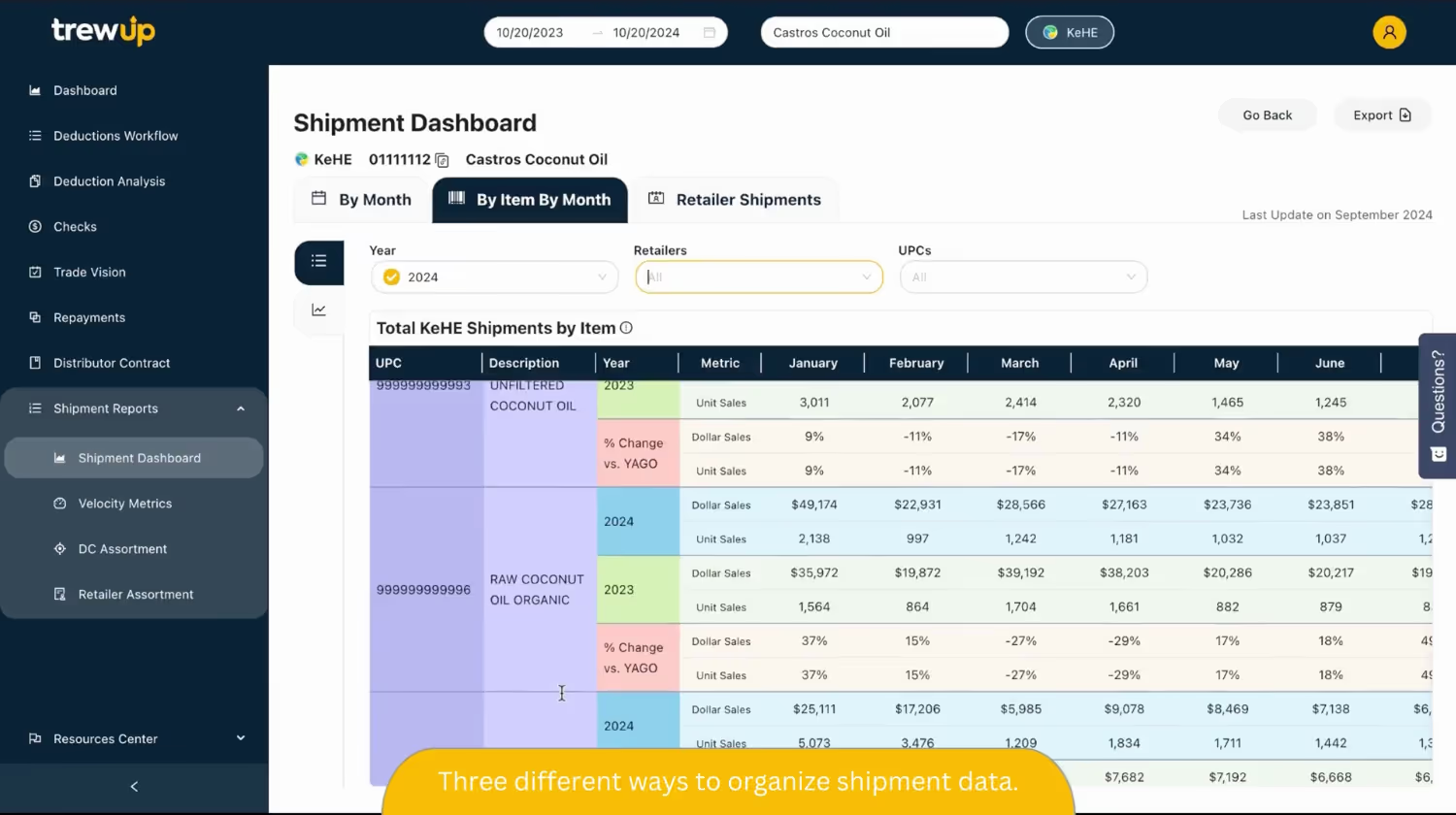
Answering that well typically requires combining shipment data (what sold into the distributor) with deduction data (what the promotion actually cost) and, ideally, syndicated point-of-sale data like SPINS (what actually sold through the register to the end consumer). Shipment data alone can be misleading. A brand can ship a large order into a distributor's warehouse and feel good about the numbers, only to have most of it sit unsold and generate deductions later as spoilage or returns. Consumption data is what tells you whether a promotion actually moved product off the shelf, and pairing it with the true cost of the promotion is what tells you whether that lift was worth what it cost. Most mid-market teams don't have the hours to assemble that combined view for every promotion, so this step is either done for a handful of high-profile promotions or skipped entirely.
7. Optimization
This is the point of the whole exercise: deciding whether to repeat a promotion, adjust its depth or frequency, or reallocate spend to a different retailer. Every one of those decisions depends on everything upstream. Without accurate deductions, trustworthy accounting, retailer-level visibility, and real post-promotion analysis, optimization is really just a guess dressed up as a decision, and teams tend to default to repeating whatever they did last year simply because they don't have evidence to justify doing anything else.
Where the Lifecycle Loses Momentum

The lifecycle doesn't have to close. For most brands, it doesn't, and it tends to come apart in three specific places.
No ROI visibility. Brands pay for deductions without knowing what actually drove the result behind them. Sales sees volume. Finance sees a ledger. Neither one has the full picture of what the spend actually bought.
Latency. By the time deductions are reconciled, weeks or months after a promotion ran, the window to act on what happened has usually closed. The information arrives too late to change the decision it should have informed.
No clear ownership. Sales owns volume but not cost. Finance owns the ledger but not the strategy. Leadership owns the P&L but often lacks the drill-down visibility to know where to intervene. Without a shared source of truth, every team ends up working from a slightly different version of what happened.
Put together, those three gaps are why so many brands stay stuck in a loop of plan, execute, deduct, and repeat, with no real learning in between.

From Data to a Decision
There's a useful way to think about what closing the loop actually requires, beyond just "more visibility." It helps to separate four distinct things that often get treated as the same thing:
- Data is the raw input: a deduction PDF, a shipment file, a contract.
- Information is that same data organized into something a person can actually read: categorized, matched, structured.
- Insight is what a person concludes after looking at that information: this retailer is driving our overspend, this promotion depth isn't paying for itself.
- Action is the decision made based on that insight: adjust the plan, dispute the deduction, reallocate the spend.
Most of the manual work in the trade spend lifecycle happens because brands are trying to jump straight from data to insight without the information step in between, which is exactly why it takes so long and why the results are so often incomplete. The insight and the action should still belong to the people who run the business. The information step, turning a stack of PDFs and portals into something structured and readable, is the part that's genuinely solvable, and it's the part that platforms built specifically for trade spend, like TrewUp, are designed to handle.
Closing Thoughts
Trade spend isn't complicated because the concepts are hard. Planning, execution, deductions, accounting, visibility, post-promotion analysis, and optimization are each reasonably straightforward on their own. It's complicated because the data needed to move from one stage to the next is scattered across distributor portals, PDFs, spreadsheets, and systems that don't talk to each other, and because most mid-market teams don't have the headcount to stitch it back together by hand every cycle.
Understanding the full lifecycle, and being honest about which stages your team can actually see clearly today, is the first step toward closing the loop instead of just repeating it.