
KeHE Deductions: Types, Codes, and How to Dispute

Your KeHE remittance lands with fifteen deduction line items and a 180-day dispute clock already running. Some of those deductions are winnable. Some are contractual costs you'll never recover. A few are aging toward a deadline that closes for good once missed.
Every KeHE supplier sees the same mix: shortage claims, promotional chargebacks, compliance fines, unsaleables, and retailer pass-throughs. The problem isn't filing disputes. It's knowing which line items deserve the fight before the window closes.
That's a visibility problem before it's a dispute mechanics problem. This guide breaks down each KeHE deduction type, shows which codes are worth disputing, and walks through filing in K-Solve so winnable dollars stop aging out of reach.
Main Takeaways
- KeHE deductions fall into distinct categories: Unloading Discrepancy Reports (UDRs), Manufacturer Chargebacks (MCBs), unsaleables, compliance fines, and retailer pass-throughs.
- Shortage disputes are winnable only with a proof of delivery (POD) signed by a KeHE employee and a written UDR response within 48 hours. A bill of lading (BOL) signed at your dock won't reverse the distribution center count.
- Mandatory costs like the 2% payment terms discount, the 2% Connect BI allowance, and the 8% MCB processing fee are contractual and non-disputable.
- KeHE enforces a 180-day dispute window. Deductions not filed in K-Solve within that period are contractually waived.
- Flag anything past 120 days as critical priority. KeHE's guidance is to allow up to three weeks per review, so a denial after day 150 leaves no room for a second filing.
KeHE Deduction Types, Codes, and What They Mean on Your Remittance
KeHE deductions are amounts withheld from supplier payments for shortages, damaged goods, promotional chargebacks, or compliance penalties. Each one carries a code on your remittance. You can dispute them through K-Solve within a 180-day window. Knowing what each code means helps you decide which ones deserve your team's time.
Unloading Discrepancy Reports (UDRs) and Shortage Claims
A UDR is the report KeHE issues when the case count at its distribution center (DC) doesn't match your purchase order (PO) at receiving. If the DC counts fewer cases than you shipped, KeHE deducts the difference at PO price. Two rules in the KeHE Supplier Policies and Procedures decide whether that deduction is winnable. First, the DC count governs. KeHE states it isn't bound by documents signed at the point of origin by its own drivers or third-party carriers, so a carrier-signed BOL from your dock won't reverse a shortage on its own. Second, you must respond in writing within 48 hours of the UDR notification, or the count stands.
Shortage disputes are winnable when your backup shows the DC count itself was wrong: a POD signed by a KeHE employee, the PO number, and your written UDR response. Section 4.4 of the policy lists that package as the required backup for any repayment request. Without it, KeHE's stated policy is not to repay short quantities that a UDR supports.
Manufacturer Chargebacks (MCBs), Unsaleables, and Compliance Fines
An MCB is a deduction for promotional funding a retailer earned through a supplier-authorized deal, such as a scan, temporary price reduction (TPR), or ad fee. KeHE bills it back to you. MCBs are aggregated by DC and charged back bi-weekly, plus an 8% processing fee with a $65 minimum per DC, per KeHE's Fee Schedule.
That volume keeps growing. In Deloitte's 2025 Consumer Products Industry Outlook, 76% of CPG executives said they planned to run more promotions in 2025 than in 2024. More promotions means more chargebacks hitting your remittance each cycle.
MCBs are disputable only when the promo terms don't match what you authorized. Verify each line against your trade calendar before filing. This is where volume overwhelms manual review: AI-assisted matching compares each chargeback's retailer, date range, funding rate, and stock keeping unit (SKU) scope against your signed promo contracts and surfaces the mismatches for your team to review.
Unsaleables are any product removed from KeHE's primary distribution channel, whatever the reason. Section 9 of the Supplier Policies and Procedures splits them into three groups, and the supplier carries the cost in all three. Discontinued or underperforming product is credited back at KeHE's landed cost, plus a per-unit disposition processing fee per the Fee Schedule, whether KeHE, the retailer, or you made the discontinuation call. Warehouse spoils (short-dated or expired stock in KeHE's DCs) are also charged at landed cost, and you have 14 days from notification to arrange return shipping or KeHE donates or discards the product and bills you anyway. Retailer spoils come through either as store-level billbacks plus a per-unit processing fee, or as a fixed spoilage allowance built into KeHE's price to the retailer. Non-conforming product (recalled, damaged, misbranded) is replaced at your cost, including freight and disposition.
Compliance fines penalize routing guide violations, pallet configuration failures, missed delivery appointments, and labeling errors. KeHE requires an 85% quarterly on-time delivery (OTD) rate. Each late shipment in a quarter that falls below the threshold triggers a $250 fee, per KeHE's Inbound Routing Guide Fee Schedule (November 2025).
Retailer pass-through deductions round out the list. These are charges that originate with a retail customer (ad fees, slotting, scan allowances, demos) and that KeHE passes through to you on your remittance, along with an extra performance processing fee. Pass-through disputes carry an extra condition. Even when KeHE agrees the deduction was wrong, it repays you only when and if the retailer repays KeHE (Section 4.4). Winning the case in K-Solve is step one; the money still depends on the retailer.
Retailer audit claims are the exception to normal timing. KeHE can pass them through beyond two years, and it deducts internal and retailer audit findings immediately, with 30 days' notice only when a third-party auditor found the claim (Section 4.9).
KeHE Deduction Code Reference Table
KeHE tags each deduction with a two- or three-letter invoice prefix that identifies who originated the charge: KeHE itself, a retail banner, or a program. General invoice adjustments append IA to the invoice number, so INV1234567 shows as INV1234567IA in K-Solve with a negative amount. The prefixes below are drawn from KeHE's Invoice Prefix Key, available in KeHE Connect. The full key runs to more than 100 codes because each retail banner carries its own.
The table maps common deduction types to their prefixes, what triggers them, how finance teams typically book them to the general ledger (GL), and whether they're worth disputing. Use it when sorting deductions for GL coding. GL treatment reflects typical practice; confirm with your controller.
Which KeHE Deductions Are Worth Disputing: A Triage Framework

Before you open K-Solve, sort your deduction queue into three buckets:
- High-probability disputes: Shortage claims where you have a KeHE-signed POD and responded to the UDR within 48 hours. Invoice price gaps where your PO confirms the correct price. KeHE pays the lower of its PO net price or your invoice amount (Section 5.3), so the PO is the reference that wins.
- Low-probability disputes: Shortage claims backed only by an origin-signed BOL, or where the 48-hour UDR response window was missed. Pass-through disputes where the retailer has not reimbursed KeHE. KeHE's DC count governs when no counter-documentation exists.
- Non-disputable mandatory costs: Set by KeHE's Supplier Policies and Procedures, with rates in the accompanying Supplier Fee Schedule (November 2025). Budget for them; don't dispute them.
- Connect BI allowance: 2% of the net value of every PO, taken off-invoice as a separate line (Section 7.1).
- Payment terms discount: 2% when KeHE pays within 10 days (net 30). Seasonal SKUs, pre-packs, and new DC openings carry special-event terms (Sections 4.1 and 4.2).
- MCB processing fee: 8% of the MCB amount, with a $65 minimum per DC, billed with each bi-weekly MCB cycle (Section 7.4).
- Extra performance fee: 8% of the retailer invoice for scans, ads, demos, placement, and slotting that KeHE passes through, with a $35 minimum and $700 maximum per invoice (Section 7.5).
Sorting by disputability before filing saves time. Your team spends recovery hours on shortage claims with KeHE-signed PODs and price gaps with PO backup. Contractual costs that were never winnable stay off the queue.
The 180-Day Dispute Deadline and Why It Got Stricter in 2025

KeHE enforces a hard 180-day dispute window in K-Solve. Suppliers must submit a detailed dispute request, including a KeHE-signed POD and PO documentation, within 180 days of the deduction date. Any deduction not filed in K-Solve within that period is contractually waived and can't be recovered.
Section 4.4 of the KeHE Supplier Policies and Procedures states that after 180 days, "Supplier's objection is waived." That language got sharper on November 1, 2025, when KeHE updated its Supplier Policies and Procedures, Inbound Routing Guide, and Fee Schedule. The refresh removed the softer wording of earlier editions. The 180-day window now reads as a firm contractual deadline, not a guideline. Deductions that age past it become permanent margin loss, and the policy provides no appeal path once the window closes.
An aging audit keeps winnable dollars from slipping past that wall:
- Pull all open deductions from K-Solve. Keep your own records at least two years, since KeHE reserves the right to audit that far back.
- Sort by deduction date, not the date you found the line item.
- Flag anything past 120 days as critical priority.
- Confirm documentation readiness (KeHE-signed POD, PO, UDR response) for each flagged item.
- File high-probability disputes first, starting with the oldest.
KeHE's guidance to suppliers is to allow up to three weeks for a formal response. The 120-day flag exists because two review cycles need to fit before day 180. Anything past 150 days has room for one filing only, so it has to be complete and correct the first time. TrewUp matches each K-Solve deduction to its code and backup and automatically flags duplicates and invalid charges on its own, so your team runs this aging audit in minutes instead of finding expired items at month-end.
How to Dispute a KeHE Deduction in K-Solve

Filing a KeHE dispute happens through K-Solve inside KeHE Connect. It's the system of record for all deduction history and dispute cases, and the policy requires that repayment requests be submitted electronically there.
Access K-Solve and File Your Dispute
- Locate the deduction. Log into KeHE Connect and go to Sales Orders > Credits > K-Solve. Use the filters to find the deduction by date, PO number, or prefix. Review the detail and category.
- Download backup documentation. Click the document icon to pull KeHE's supporting files. MCB backup is provided through the portal.
- Gather your proof documents. Assemble the POD signed by a KeHE employee, the original PO, and your written UDR response before opening the case. For promotional deductions, add the promo authorization or trade calendar entry.
- Open a dispute case and attach files. Use the dispute icon in K-Solve to open the case. Upload all supporting documents up front; incomplete submissions are the most common reason disputes stall.
- Describe the gap clearly in the notes field. State what was shipped, what was charged, and why the deduction is wrong. Reference case counts, PO line items, and delivery confirmation numbers.
- Record your ticket number and set a follow-up reminder. KeHE's guidance is to allow up to three weeks for a formal response. Avoid duplicate filings before that window passes.
What Happens After You Submit
KeHE reviews the case against its DC records and your documentation. If approved, the credit appears on a future remittance. It won't come as a separate payment. If denied, review KeHE's denial reason in K-Solve.
When you have documentation that wasn't included at first (a KeHE-signed receiving record, for example), resubmit before the 180-day window closes. If the denial is based on KeHE's DC count and you have no counter-documentation, the deduction is likely final.
When the same deduction type keeps recurring, the fix is upstream: electronic data interchange (EDI) hygiene, pallet configuration, routing compliance. The policy gives you the levers. EDI is mandatory for PO transmission and confirmation (Section 5.1), so advance ship notice and invoice accuracy is where most shortage and pricing disputes are prevented. Monitor at-risk inventory in Connect BI; KeHE holds you responsible for discontinued and short-dated stock whether or not you use the reporting (Section 9.1). And submit promotional allowances through the Promotional Roadmap before the published deadlines (Section 7.2), since that submission is the record an MCB dispute is checked against.
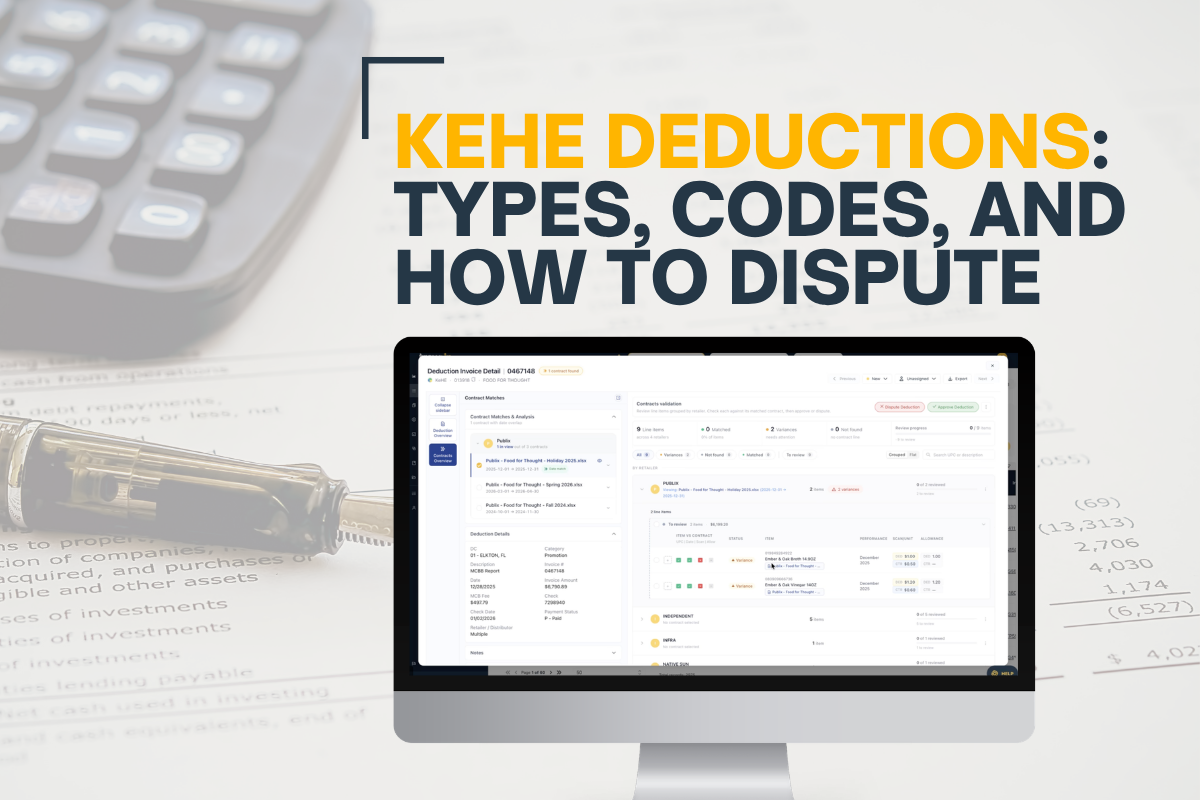
For teams processing high deduction volume, TrewUp pulls deduction data directly from K-Solve and automatically categorizes each one with GL-ready data. Your queue is ready for review and dispute, not data entry.
Start Protecting Your KeHE Margin with TrewUp

You now have a framework for reading KeHE deductions by type and prefix, ranking your queue by disputability, and filing before the 180-day window closes. That turns deduction processing from a monthly backlog into a controlled workflow. Winnable dollars get recovered. Contractual costs get budgeted.
We built TrewUp to automate what this article describes manually. Every KeHE deduction gets pulled from K-Solve and categorized automatically with GL-ready data, with 12 months of history at onboarding. TrewUp’s proprietary AI matches each one to its code and backup and automatically flags duplicates and potential errors, so your team reviews exceptions by aging risk instead of decoding remittance PDFs. To date, TrewUp has processed more than $1.1B in deductions.
Sorted, dated deduction actuals do more than protect the dispute window. They're the raw material for post-promotion analysis and smarter planning. Once every MCB and pass-through is tied to the promotion that generated it, you can see what each KeHE deal actually cost, by retailer, and which ones earned their spend. The contra-revenue lines in the table above are your true gross-to-net deductions, and they're the numbers your next promotion plan should be built on.
That's the shift from reacting to deductions to managing trade spend as a business lever. Profitability starts with visibility.
KeHE chose TrewUp as its deductions management partner because the platform reads K-Solve data the way KeHE structures it. That's what lets TrewUp take on the manual sorting in this article, so your team spends its time on decisions.