

Main Takeaways
- Trade promotion optimization evaluates post-event actuals to find which promotions drove profitable volume.
- To get clean actuals for accurate ROI calculation, categorize deductions and reconcile spend.
- Planned vs. actual variance and deduction match rate show whether your data foundation is trustworthy.
- Optimization playbooks differ by retailer types. Each produces distinct deduction patterns and lift profiles.
What Is Trade Promotion Optimization?

Trade promotion optimization evaluates post-promotion actuals, including deductions, depletions, and event-level spend. The goal is to find which promotions drove profitable volume.
It’s part of trade promotion management, which includes setting the calendar and committing the budget for promotions. If your team can't tie actual trade spend back to a specific promotion, every ROI figure you report is an estimate.
With CPG marketing budgets at a five-year low of 6.7% of revenue, according to Gartner, estimates aren't good enough to guide reinvestment.
The Trade Promotion Optimization Process: 6 Actuals-First Steps

The trade promotion optimization process runs in six steps. The first three build a reliable actuals foundation. The rest use that foundation for ROI measurement, scenario planning, and better allocation. But none of it works if the actuals aren't clean.
1. Build Your Data Foundation
Five data inputs make it possible. Each lives in a different place, and each has a common failure mode that can stall the process:
- Customer/item master: Consistent identifiers linking retailer accounts to items differ between distributors and retailers.
- Deductions: Chargebacks, billbacks, trade claims, and fees pulled from distributor portals and PDFs tend to arrive 60–90 days after the event.
- Depletions: Unit item IDs sold through to retail, sourced from distributor depletion reports, often don't match across systems.
- Promotion plans: Your event calendar and planned spend are in different files with no standard format.
To build a reliable data foundation, you need to know the:
- Promotions
- Deductions
- Depletions
- Item/customer mapping
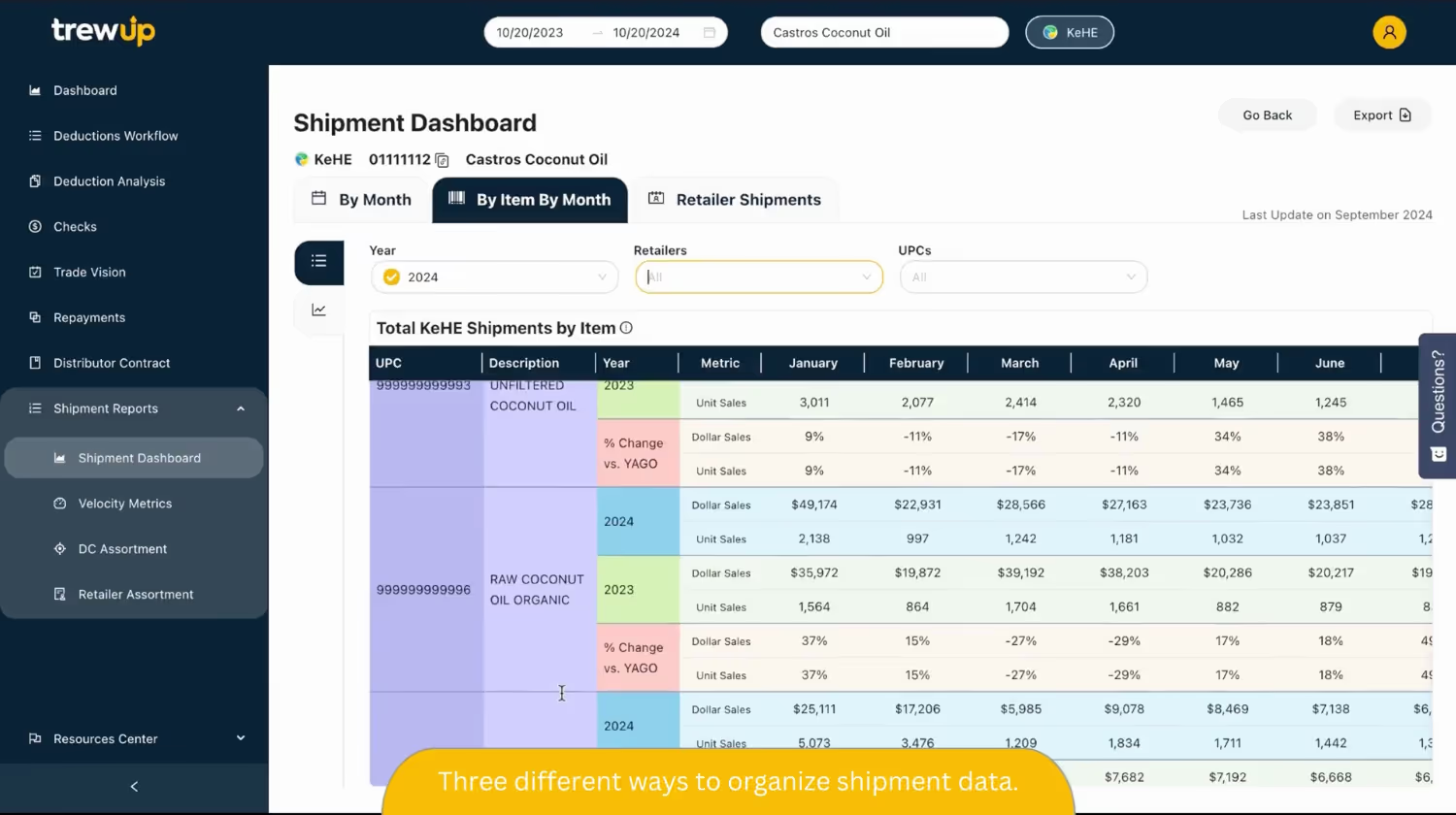
Most teams stall because deductions data is scattered across portals and PDFs. TrewUp is built for deduction management. It automatically pulls and structures data from UNFI, KeHE, and Kroger, so your team isn't chasing files across systems.
2. Categorize and Match Deductions to Promotions
Once the data is collected, categorize each deduction by type and reason code. Then match it to its specific promotion, retailer, and SKU. Flag anything that doesn't match or looks unexpected for review. This step converts raw claims into usable trade promotion analytics.
This is also the biggest bottleneck. When categorization and matching fall behind, deductions pile up in a backlog. They never become actuals you can analyze. Instead, someone writes them off at close.
3. Reconcile Planned vs. Actual Spend
Diagnosing this variance requires knowing deduction details (retailer, SKU, and week). A lump-sum write-off tells you nothing.
Sonoma Creamery uncovered $60K in incorrect deductions through this type of validation. That's proof that reconciliation directly protects margin.
4. Compute Event-Level ROI
With planned and actual spend reconciled, you can calculate true ROI per event.
(Incremental Revenue – Actual Trade Spend) ÷ Actual Trade Spend
Each completed cycle sharpens your baseline and lift estimates, improving trade promotion forecasting.
5. Run Scenarios and Adjust the Next Cycle
Clean actuals unlock scenario testing. You can model what happens when you change discount depth or shift promotion weeks.
Predictive analytics in trade promotion planning (including AI-driven models) can:
- Forecast lift
- Estimate cannibalization and halo effects
- Recommend scenario mixes
Yet today, just 19% of retailers use AI to improve pricing and promotions, per FoodNavigator.
6. Feed Results Back into Planning
Use updated lift estimates, revised spend allocations, and adjusted mechanics in the next planning cycle.
2025 retail sales grew just 3.7%, according to the U.S. Census Bureau, so cutting non-incremental events matters more than chasing volume. Redeploying those dollars to proven mechanics is a bigger margin lever.
Measuring Trade Promotion Effectiveness: KPIs That Require Actuals

Measuring trade promotion effectiveness requires tracking KPIs. Every number in the table below is only as trustworthy as the actuals behind it. If your deductions aren't categorized and matched to promotions, the ROI and variance only show estimates.
Trade Promotion Key Performance Indicators
Retail Promotion Optimization by Channel and Retailer Type
Retail promotion optimization demands different playbooks for different retailer types.
For example, in Q3 2024, 31.4% of units in grocery and mass market were sold on promotion. Convenience hit just 21.2%, according to NACS.
Your expected lift, deduction volume, and CID should reflect the retailer's promotion model.
At EDLP retailers—certain club and value chains—trade spend is baked into every unit. Optimization centers on everyday price positioning and trimming unnecessary off-invoice discounts.
Deductions tend to be steady and lower-depth. The goal is to close the gap between your planned trade rate and what actually gets deducted per case.
High/low retailers concentrate spend in deep, periodic TPRs. The optimization levers are discount depth, promotion frequency, and mechanic type (scan versus MCB).
Deductions are spikier and harder to reconcile because they cluster around event windows. Tight matching prevents lumping multiple events together.
Hybrid retailers blend everyday pricing with periodic deals. The challenge is separating baseline trade allowances from event-specific deductions.
For distributor-heavy brands, retail promotion optimization means building extra time into reconciliation windows. Make sure your item/customer master maps distributor codes to retailer accounts.
Start Measuring True Trade Promotion ROI with TrewUp

TrewUp brings together deduction, depletion, and promotion data. The platform pulls directly from distributor portals and retailer sources, so your team stops chasing files.
Finance and sales work from the same promotion actuals. They close faster with validated trade spend and reallocate dollars based on ROI they can defend.
See how TrewUp connects post-invoice deductions and depletion data to specific promotions. Empower your team to measure true ROI by retailer and SKU—book a demo.